
Crab Season's New New Reality Isn't What You Expect
By Mark C Anderson, March 9, 2026
For at least one crab lover, it was the best Christmas ever.
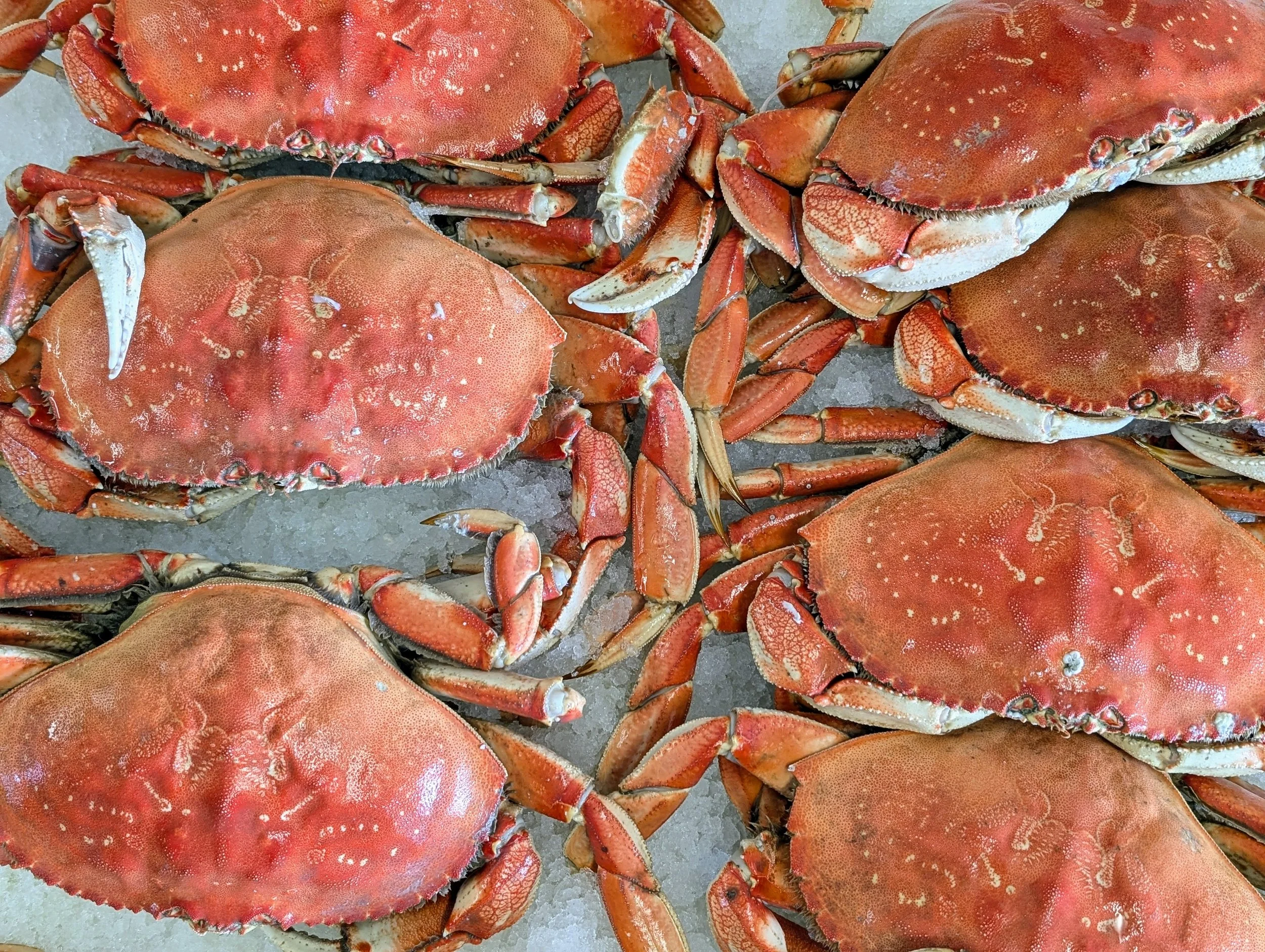
Photo credit: Mark C Anderson
Pinch-me-fresh, straight-from-the-Monterey-Bay Dungeness crab was so plentiful that whole crabs were going for $7 down at the end of Monterey’s Municipal Wharf.
That’s not per pound, that’s the entire crustacean.
I bought as many as I had cash for—11 crabs, boiled that morning—and launched into what I remember now as “The Adventures of Crab Santa.”
That’s where you skip the chimney but still tiptoe into the homes of family and friends while they’re at work and stack fresh crab on fridge shelves in interesting formations, like you might with gifts under the tree.
Newsflash: That was a long time ago, early 2010s style, and crab season on Monterey Bay isn’t going to be like that again.
BUT, all caps and italics intended, that’s not entirely bad, because there are some things about the changing fishery that have insiders not just optimistic, but almost giddy.
•••
Not quite as far back as the Crab Santa days, circa spring 2022, I came across a seafood controversy that got so intense that several fishermen I interviewed mentioned they had received death threats for how they caught crab.
Yes, fishermen were menacing other fishermen with murder. (Thankfully, it was talk.)
But such was the crisis Monterey Bay fishermen were facing. Those under threat had decided to test out a different kind of crab pot called “pop-up,” “on-demand” or “ropeless” traps (erroneously, in the last case, because they still use ropes).
Originally from the East Coast, where lobster fishermen were experiencing a higher entanglement risk with endangered right whales, necessity was the mother of this new pot invention.
The tricky part was adapting that gear—fished off New England in relatively shallow waters—to the deeper crab grounds off California.
Instead of deploying the crab pots and “soaking” them at the ocean floor with long vertical lines connecting a buoy at the surface over a period of days, the “pop-up” traps contained those ropes and flotation devices at depth.
Fishermen could use GPS technology to locate and then retrieve them by Bluetooth signal that would summon them on the spot.
The idea was to reduce the risk of entangling whales and sea turtles visiting the California coast each spring, while allowing crabbing to continue.
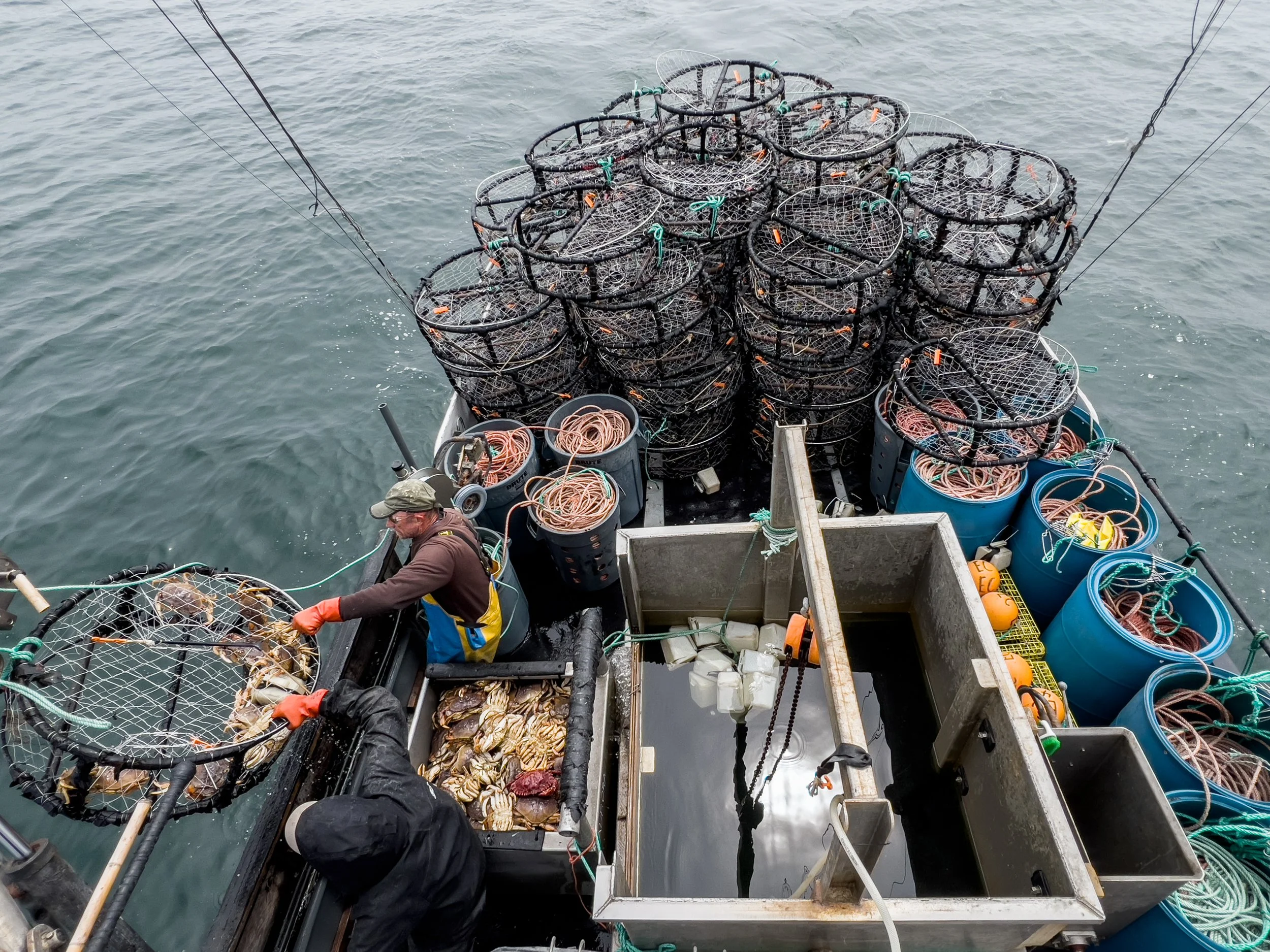
.Photo Credit: National Marine Sanctuary Foundation (NMSF)
The fishermen—and their customers—were caught in a bit of a trap themselves. They don’t want to harm wildlife, but they could see that by supporting the testing of this new and expensive technology, they might be accelerating the demise of their own conventional crabbing livelihood, which still makes up the bulk of their revenue, even during truncated seasons.
An unofficial boycott of the new devices descended, enforced with occasional fisherman-on-fisherman peer pressure and even intimidation.
One fishery expert calls that moment “an existential crisis for the fleet.” Given the informal—but intense—pop-up boycott, not many crabbers tested them the first go-round. Those who did…did so quietly. By the second year, a few more had decided to try them out.
•••
Flash forward three years. Spring 2025 marked the third consecutive year local fishermen tested so-called “pop-up” crab pots using Experimental Fishing Permits (or EFPs) issued by the California Department of Fish and Wildlife (CDFW) after the season closed for conventional crabbing in early April to prevent entanglement risk to whales.
It was the most significant activity yet. At least a dozen commercial California Dungeness crab fishermen, working out of harbors from Morro Bay to Crescent City and using EFPs led by Sub Sea Sonics and National Marine Sanctuary Foundation, brought in $1.4+ million of crab in 2025, entirely on pop-up gear.
According to the data they were required to collect as part of the EFP, the team was able to evaluate retrieval rates and declare success despite tricky spring weather conditions. They reported that 120 fishing trips, 1,163 strings of gear, and 25,721 trap deployments resulted in 98% trap recovery (and 100% with the use of grappling hooks as backups).
So, it was starting to look like the new gear was worth the investment and viable in deeper waters.
Stephen Melz is an early pop-up adopter, fishing out of Pillar Point Harbor in Half Moon Bay.
He flags several benefits of the new traps, including the fact that buoys don’t get covered by algae and barnacles like they do sitting for long intervals at the surface, so his gear and vessel stay a lot tidier.
“Everything’s clean and super nice to work with,” he says, before acknowledging a larger surprise: harmony between conservationists and commercial fishermen.
“Normally, NGOs and fishermen are at battle, on either end of the spectrum,” he says. “This was one of the first times we worked hand in hand to make sure, yes, the whales are safe, but fishermen have the opportunity to bring in [Dungeness] crab to the public.”
He goes on to describe reinvigorated dock sales in Half Moon Bay and beyond.
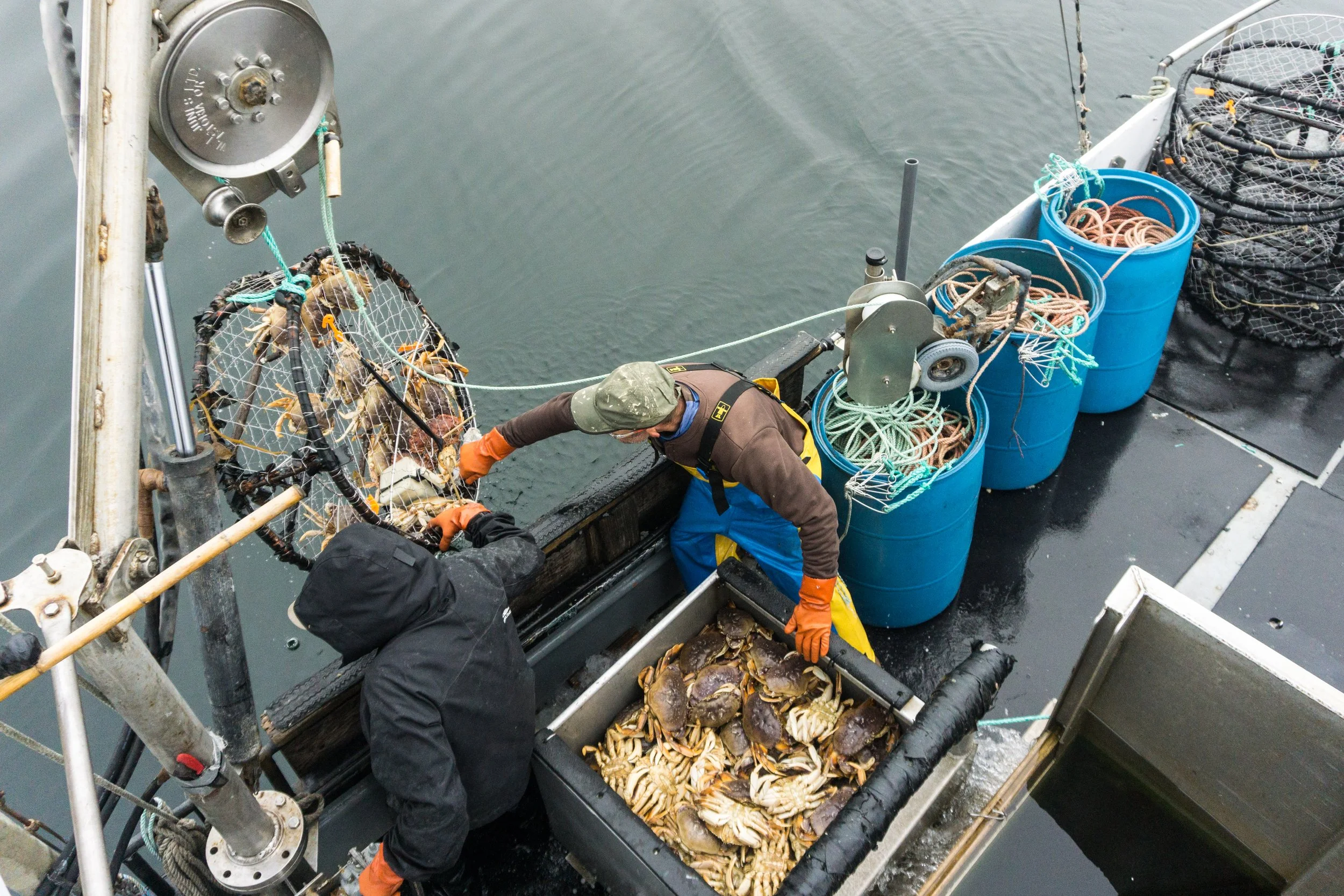
Retrieving traps during trials.
Photo Credit: National Marine Sanctuary Foundation (NMSF)
“A lot of the news reports have talked about ‘the poor fishermen,’ but what about the people of California?” he says. “It’s their commodity. They’ve lost the opportunity to get access to fresh crab. Now, for spring and summer, the people of California are the big winners. Now the season’s going all the way to June 30.”
Khevin Mellegers, who fishes out of Santa Cruz Harbor and has participated in the EFP since its inception, was among those ready to try a new tack after the spring crab season has been effectively “on ice” in Central Coast California for the last six years.
“My intentions were to [test] this for myself [and] my family,” he says, “and also to help provide something for a lot of the other smaller boats.”
•••
The spring 2025 outcomes qualify as encouraging. Oceana conservationist and senior scientist Geoff Shester would call "encouraging" an understatement.
“The results of this spring’s pop-up gear testing are nothing less than wildly successful,” he said when the results were published, adding that even with a vast increase in the amount of gear each fisherman was allowed to use, not one string of fishing gear went missing. “This world-class testing proves once again that this innovative fishing gear is successful, profitable, enforceable, whale-safe, and ready to restore a vibrant spring crab fishery.”
The manufacturer of the first pop-up traps authorized for general use without a permit, Sub Sea Sonics, is run by Bart Chadwick. He deserves a solemn nod for navigating the double migraine of fleet politics and fishery regulation at the state level—but he prefers to credit the ones fishing.
“It really came down to the will of the fishermen,” he says. “None of this could ever happen unless some decided they didn’t want to sit around and not fish. The state, for a while, was deferring to the fleet. They weren’t going to push for something unless the fleet wanted it.”
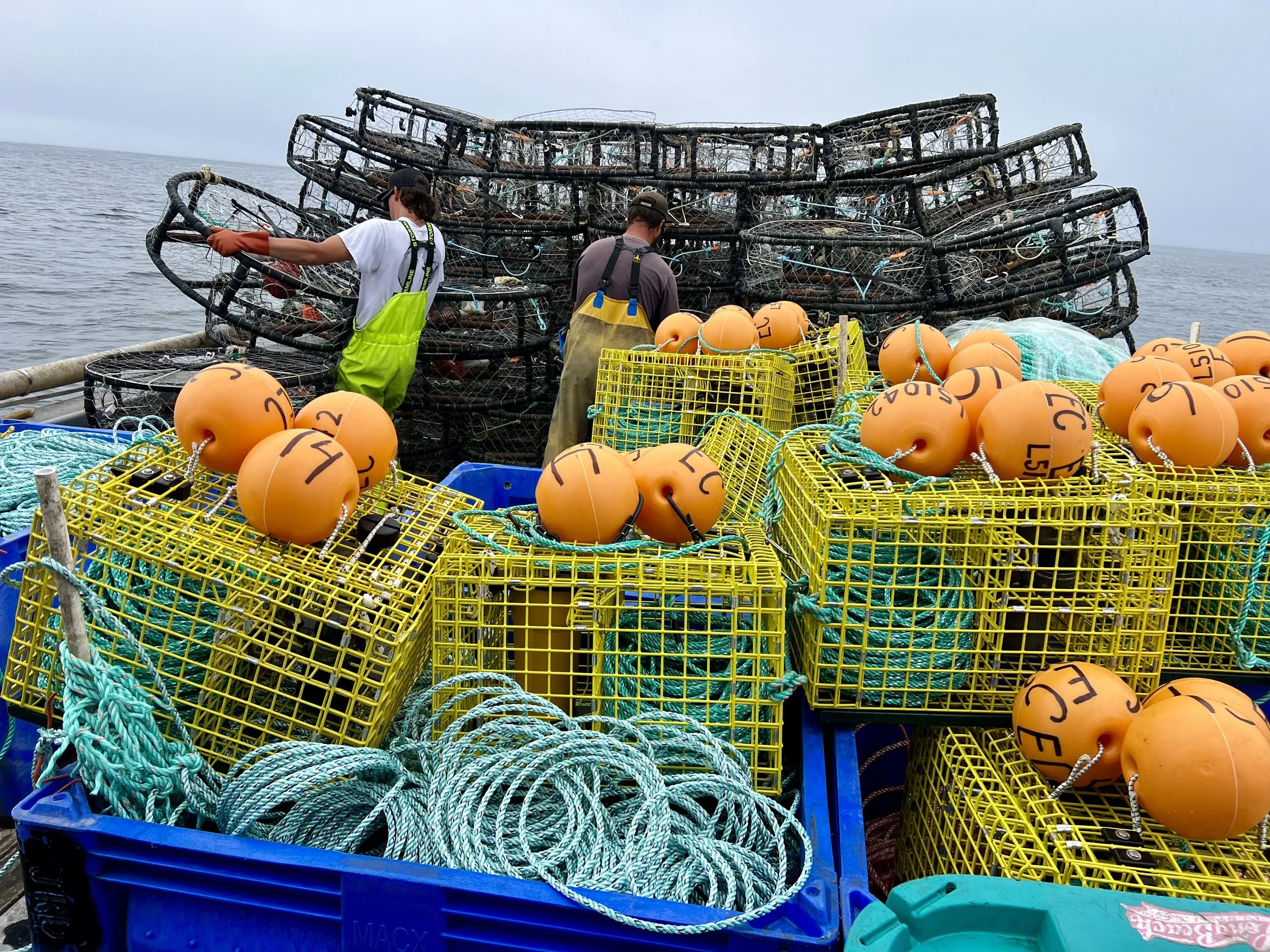
Testing on-demand across Monterey Bay, crabbers took to pairing conventional gear (in the background) on strings of 10 attached to one pop-up (foreground)
Photo Credit: National Marine Sanctuary Foundation (NMSF)
He adds sly adjustments from fisherfolk like Melz, including attaching one pop-up trap to an ocean-floor line with a group of traditional traps—rather than using single pop-ups independently—brought down costs and raised recovery rates.
“That was the magic that made it work,” Chadwick says. “That got the reliability up and made it more affordable.”
The testing results contributed to another major development: Last month CDFW approved the use of two pop-up trap designs, one manufactured by Sub Sea Sonics, the other EdgeTech, for use from April 1 to July 15. In other words, no EFP or months-long application process is necessary, just a person’s willingness to invest in the new gear and a license.
“The playing field is level now, not separated by whether you have a [EFP] permit or not,” Shester says. “It prevents a ‘have and have nots’ problem, and any sense of unfairness.”
He notes the Endangered Habitats League is offering limited $5,000 discounts on new pop-up gear, and the authorization allows manufacturers to more confidently invest in product development.
Also, California Farmlink and Euphotic Foundation are offering loans and grants (respectively). See our March 2026 Buoy Bulletin for details.
Meanwhile, the National Marine Sanctuary Foundation stocks its Innovative Gear Library with pop-up technology that it loans to local fishermen.
Gear Innovations Manager, Greg Wells, encourages fishermen to complete a Gear Library Expression of Interest to shorten the wait to train with and start using the various systems they stock.
“When [fishermen] decide they want to do it, we provide training in collaboration with the manufacturer, and give them practice deployments, until they say, ‘OK I got it. Ready to go,’” Wells says. “The sooner they reach out, the sooner we can get them set up.”
Not that it’s all happy crab cracking. Tension around the fishery persists.
One veteran crabber told the Trust that the pop-up testing is Fish and Wildlife’s way of “consolidating the fleet, so it will just be big boats,” adding, “A little guy can do it, but it costs a lot of money for a small operation…the whole idea is to get us off the water fishing with standard gear.”
Another longtime crabber feels fishery closure timelines remain far too hard to plan around. “They feel arbitrary,” he says.
Another still believes on-demand traps are foolishly complicated, adding, “The grapple technique is a fisherman-designed method that works for any size boat: Fishermen have designed something that doesn’t need specialized equipment. It’s so easy, it’s crazy. It’s a no-brainer.”
On top of that, advocates like Shester insist there are still far too many entanglements and provide numbers to back it up. The 2024 fishing campaign saw 34 whale entanglement incidents on the West Coast, according to a NOAA report, with 31 involving humpback whales, 14 of which were directly linked to West Coast Dungeness crab gear.
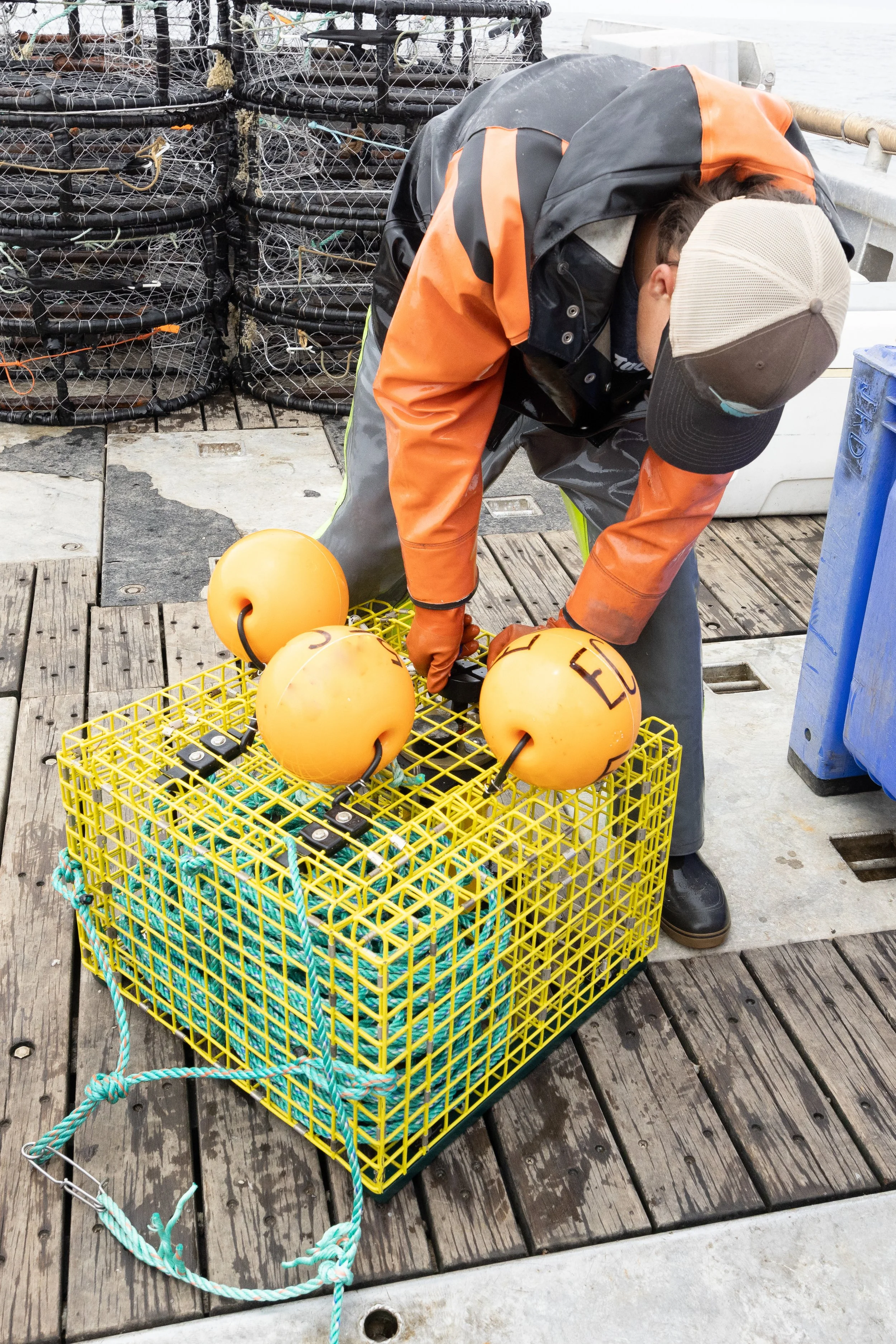

A crabber prepares an EdgeTech pop-up for deployment.
Photo Credit: National Marine Sanctuary Foundation (NMSF)
Plus, natural cycles mean crab populations are difficult to track.
But still, there’s a certain Crab Santa jolliness felt by the fishermen who have personally tested—and helped refine—the on-demand gear, Melz included.
“The reason I went out is I wanted to make sure the system adopted was good for everyone,” he says, observing he was able to equip his boat with Sub Sea Sonic traps for less than $18,000. “I wanted to make sure I tested the stuff so I didn’t have to depend on people to give me their opinion—for me, it had to be affordable, efficient, and reliable.”
He goes on to share that the team at Sub Sea Sonics took his feedback seriously, whether it was how individual pop-ups made more sense attached to a string of conventional pots, or how to design the new-era traps to look like the old-school traps fishermen know and love.
“We all came together, and the manufacturers worked with us,” Melz says. “We used the guts of their design, gave it a traditional crab pot frame, and the outcome was beautiful.”
Which feels like a holiday worth celebrating, with some Christmas-in-summer crab.
•••
For Monterey Bay locals and visitors alike, below are some ways to learn more and help support the local fleet:
Attend Whalefest 2026
The April 11-12 free-admission event at Fisherman’s Wharf in Monterey comes loaded with symposiums, interactive activities, and whale-safe crab snacks.
Expand your seafood faves
Take the continuing challenges around the Central Coast crab and salmon seasons as an opportunity to try out other abundant local seafood, like rock crab, rock cod (aka rockfish), lingcod, black cod (aka sablefish) and sand dabs. Check out MBFT’s local catch guide for more details.
Learn the (non) ropes.
At the California Department of Fish and Wildlife’s Whalesafe Fisheries page, involved citizens can sign up for updates.
Rock the dock sales.
It’s easy to receive notifications on direct sales on the harbor via the City of Monterey’s Harbor website (scroll down to “Subscribe to Harbor News Delivered to Your Email”), then bring a bucket or cooler, and ideally a lawn chair to relax in after getting there early and avoiding the huge line that materializes.
Subscribe to thrive.
Local CSFs like Real Good Fish, H&H Fresh Fish, and Ocean2Table, streamline direct access to available Monterey Bay seafood, crab when possible, as does Sea Harvest Market in Moss Landing.